A Guide to Proper Reception of the Holy Eucharist
Dear friends in Christ,
As we approach the Eucharistic Feast of Corpus Christi, Fr. Val and I decided a realignment and re-catechesis was due so that there is consistency and ease in the distribution of Holy Communion, and the Communion Rite generally. We are really appreciative of all taking a bit of time to ensure our postures and practices are uniform.
Under normal circumstances (minus a disability, etc.) there is only one proper way to receive Holy Communion within each of the two allowed methods (in hand, on tongue), but almost 40% of our parishioners across the two campuses are habitually (every time they receive, not just a one time brain cramp for that individual) receiving incorrectly in at least one aspect below. Therefore, you are in good company if you find out you’ve been misaligned, nothing to be embarrassed about, but let’s make an effort to align now. Also: parents with children or teens at home, we are asking you to check with them and have them demonstrate that they are all receiving properly as well.
A Guide to Proper Reception of the Holy Eucharist
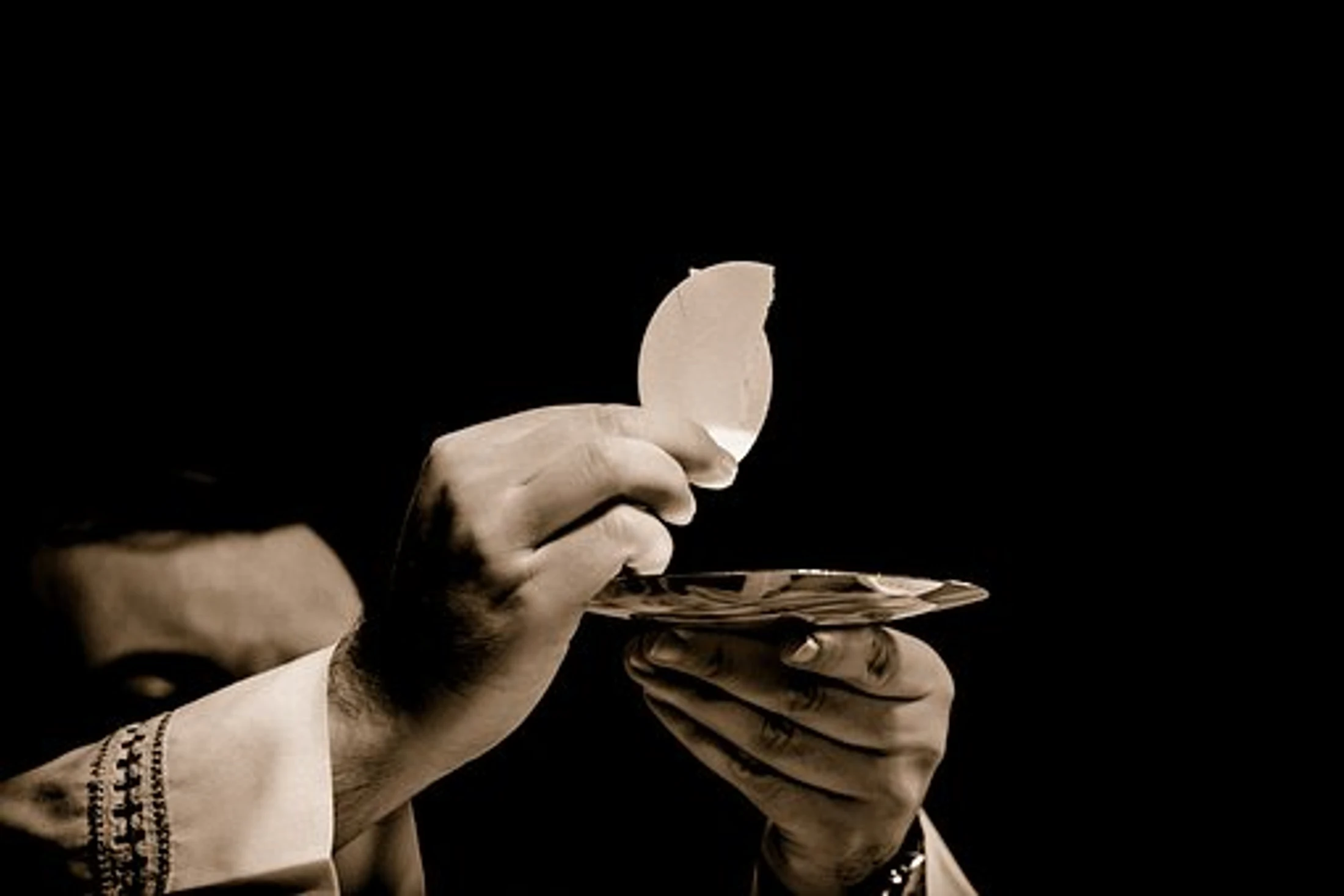
The Holy Eucharist is not merely an object; rather is a Divine Person Whom we receive—Jesus Christ, truly present: Body, Blood, Soul, and Divinity. (CCC 1374)
“In the most blessed sacrament of the Eucharist ‘the body and blood, together with the soul and divinity, of our Lord Jesus Christ and therefore the whole Christ is truly, really, and substantially contained.’”
Because of this profound reality, the way we receive Holy Communion matters. Our external gestures should reflect our interior faith, reverence, and love for the Lord.
The Church permits the reception of Holy Communion either on the tongue or in the hand. Both are legitimate when done properly and reverently.
General Disposition for All Communicants
Before considering the proper reception of the Eucharist, we should first be attentive to the proper disposition before receiving the Eucharist:
Be spiritually prepared (in a state of grace and having observed the Eucharistic fast, which is one hour before receiving Holy Communion).
Approach the minister calmly and reverently.
Make a gesture of reverence (usually a bow of the head) before receiving, and while the person ahead of you is receiving so that having completed the gesture of reverence one is ready to step forward to the Eucharistic minister immediately as the person in front of you steps away.
Respond “Amen” to the minister’s proclamation, “The Body of Christ.”
This “Amen” is an act of faith: “It is so / I believe.”As the General Instruction of the Roman Missal teaches, the communicant affirms their faith by saying “Amen” before the minister is to place the host on the palm or tongue of the communicant.
Receiving Holy Communion in the Hand
The proper manner:
Place one hand flat upon the other, forming a throne for the Lord. Traditionally, the left hand rests upon the right, though the opposite is also permitted.
If you have a disability/arthritis or need to hold a cane with one hand, an adaptation is of course acceptable.
Please avoid the following:
Holding both hands side by side or cupped
This increases the risk of the Host slipping or falling.
Holding hands too low
Hands should be raised to a natural, stable height to ensure reverence and care. Chest height is about ideal for both children and most adults.
Grabbing, pinching, raking, or taking the Host from the minister
The Host is placed on the communicant’s hand by the minister.
Holy Communion is received as a gift, not taken or snatched with one’s fingers.
Do not pinch down on the host with your finger as soon as the host touches your palm.
One’s fingernails (either hand) should never make contact with the minister’s hand.
There is no hurry to grab the host off of your receiving (top) hand.
The non-recieving hand should never make contact with the minister’s hand.
Rather, after receiving on the hand, please take a quick side-step in the direction you will return to the pew, and then take the host with your non-recieving hand and consume the Host immediately. One side-steps to allow the person behind you to approach to receive, AND because one must never turn one’s back on the minister until the Eucharistic Minister can easily verify in their peripheral view that you have consumed the host. If you have a disability or mobility issues, and cannot side-step, etc. an adaptation is totally acceptable, but please still ensure the minister can easily verify you placed the host in your mouth.
Receiving Holy Communion on the Tongue
The proper manner:
Approach the minister at a range where they can easily reach your mouth, and stand still.A stable posture allows the minister to place the Host safely and avoids accidents.
After responding “Amen,” fully open your mouth.This should be done naturally, without delay or hesitation.
Extend the tongue and keep still.The tongue should be relaxed, and rested on one’s lower lip naturally - extended just enough to receive the Host easily. One’s tongue should be still and not continually stretching out/craning forward until making contact with the host.
One’s head should be level or tilted slightly back.This prevents the host from falling.
Remain still until the Host has been placed.Do not gradually lean in. Once the minister begins to extend the host, hold completely still and do not “lean in”.
Finally, this is implied throughout the above points, but your role is to hold still until the minister places the host on your tongue.
Please avoid the following:
Biting on the Host
Please avoid coming forward to bite the Host (either with teeth or lips) which often results in the communicant making contact with the minister's hands
Keeping the mouth insufficiently open
The mouth should be opened wide, and the tongue extended slightly, to allow the minister to place the Host securely.
Things to Avoid in General
Walking away and turning one’s back on the minister before consuming the Host. The minister should be able to clearly see you consume the host in their peripheral vision; otherwise they are instructed to leave their station and “track you down” to ensure you have consumed the host.
The proper sequence is:
Bow → Receive → Step aside → Consume → turn to return to your pewChewing gum or having food in one’s mouth
This is inconsistent with the Eucharistic fast and the reverence due to the Sacrament.
Failing to say “Amen”
This response is essential. Without it, the act of reception is incomplete, and the minister technically is not supposed to give you communion if you do not say “Amen.”
After Receiving Holy Communion: Returning to Your Pew
After receiving the Body of Christ and consuming the Host, please return to your pew reverently and prayerfully.
Upon returning to your place, the Church invites the faithful to kneel or sit in a posture that best fosters silent prayer and thanksgiving.
This is a recent change in our Archdiocese. The practice of the Archdiocese from 1999-2020 was that the assembly continue to stand throughout the Communion Rite until everyone has received to emphasize the horizontal dimension (communion with one another) of receiving Holy Communion versus the vertical dimension (communion with the Trinity through receiving Jesus).
The practice of standing in one’s pew after having received communion was revoked by Archbishop Etienne in his pastoral letter on the Eucharist in 2020.
He is asking us to follow the universal norm of the Roman Rite (GIRM 43; 45; 88) which is to kneel or sit upon returning to the pew. This pastoral letter is titled "The Work of Redemption: Eucharistic Belief and Practice in the Archdiocese of Seattle" and can easily be found online if you wish to read.
Both horizontal and vertical emphases of communion are legitimate, but whether one prefers one practice or emphasis or the other, having disunity in posture during Mass is both a simple distraction and more importantly works directly against the very unity communion always symbolizes. So we are asking all to do what our current Archbishop has mandated throughout the Archdiocese.
Kneeling is a privileged posture of adoration and humble thanksgiving, long associated with reverence before the Eucharistic Lord.
Sitting is also permitted and may be chosen allowing for quiet, attentive prayer.
During this time, the faithful are encouraged to speak to the Lord in their hearts—offering gratitude, asking for grace, or simply resting in His presence. This moment after Communion is not a transition or intermission, but a sacred time of personal communion with Christ.
Out of respect for this prayerful silence:
Please avoid unnecessary movement or conversation.
Remain attentive and recollected until the Communion Rite has concluded.
In this way, our posture after Communion expresses what we believe: that we have truly received the Lord Himself, and that this gift deserves our full reverence, gratitude, and love.
A Final Word
Ultimately, it is not only how we receive, but Whom we receive.
Yet precisely because we receive Christ Himself, how we receive should reflect Who we receive.
Every gesture—our posture, our response, our care—becomes a quiet profession of faith. Let us receive the Eucharist with hearts full of reverence, gratitude, and love, so that our outward actions truly express our inward belief.